Homework and Exams with Gradescope
General information and assignment types
When to use Gradescope?
Gradescope can be used for digital exams as well as in-person exams in the lecture hall and written homework assignments. A particularly interesting feature is that students answer tasks on paper and their solutions are then scanned. Teachers can then grade the tasks online on Gradescope in detail using rubrics.
Gradescope is particularly suitable for courses with many participants and possibly several graders, as the rubric system can make grading more transparent and enable faster grading. AI grouping of short answers is also possible, which can make grading even easier, as identical answers can be graded at once.
Gradescope is connected to the TeachCenter and the TeachCenter Exam, and is always accessed via the TeachCenter or TeachCenter Exam. Students are automatically synchronised with Gradescope and the points can be transferred back to the TeachCenter (Exam).
The different types of assignments that can be created with Gradescope are briefly explained below.
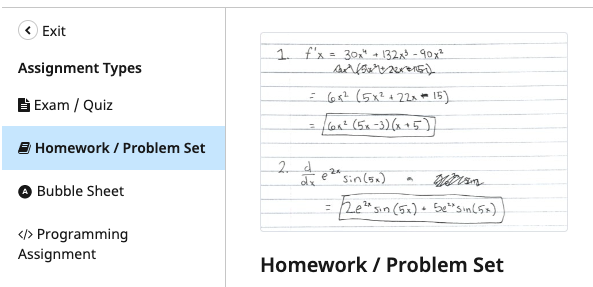
Assignment type Homework
With the „Homework“ assignment type, students download a file you provide as instructions and write their answers in their own document or on paper. The answer sheets are scanned and uploaded by the students themselves or collected by the teachers and scanned all at once. The submissions can be automatically assigned to the students by recognising their handwritten names.
Assignment type Exam/Quiz
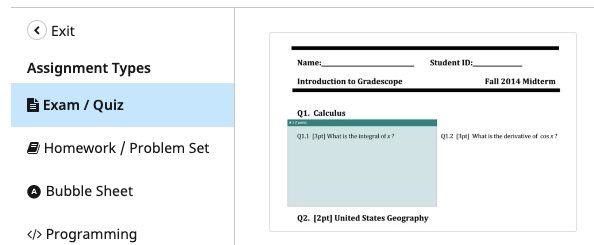
In the ‚Exam/Quiz‘ you provide students with questions with placeholders for the answers. Students write their answers on the same sheet.
You define in advance the areas in which the questions and placeholders for the answers are located. During the online grading, only this area is displayed for the respective question.
This type of assignment is suitable for free text questions, small sketches or image captions.
With this assignment type, AI grouping can be used for grading. The AI function can group identical answers together, which can then be graded with a single click. The AI feature only works with short answers (e.g. short equations or one-word answers).
Assignment type Online exam
This type of assignment is similar to a quiz in the TeachCenter Exam. You can create multiple-choice questions, essay-type questions, etc. Students answer the questions online on Gradescope.
Assignment type Bubble Sheet
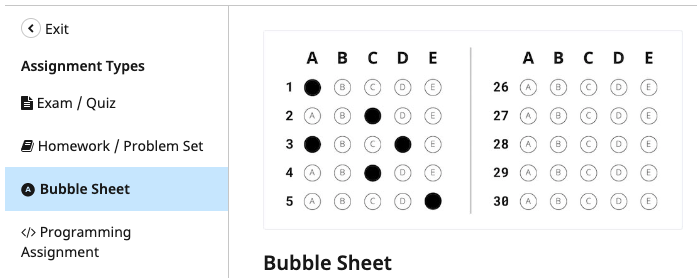
In this type of assignment, students receive a set of multiple-choice questions including answer options and an extra sheet with the „Bubble Sheet“, on which only the letters A/B/C/D/E are pre-printed.
Students read the questions on the question sheet and mark the corresponding letter on the bubble sheet, but do not see the answer texts there. The answer sheets are scanned and can be evaluated automatically, as you have already specified the correct answers online when creating the exam.
This type of assignment is suitable if only multiple-choice questions are used, all of which have the same number of possible answers. This type of assignment can be corrected very quickly using templates.
Assignment type Programming assignment
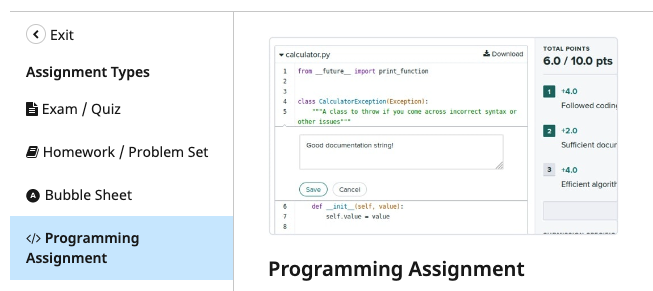
This type of assignment is similar to the Coderunner question type in TeachCenter quizzes. For programming assignments, students submit code projects, which can be graded by a custom autograder (automatic tests) and/or manually using the traditional Gradescope interface with the rubrics.
Creating and managing Gradescope assignments
Having a Gradescope activity created
- To activate Gradescope for your exam or your course, contact TeachCenter support with a link to the TeachCenter or TeachCenter Exam course in which Gradescope should be activated. If there is no course yet, TeachCenter support will be happy to create one for you.
- Even if you hold an exam in the lecture hall, please contact support and you will still receive a TeachCenter Exam course. The course is used to manage students, and students can then view their points online.
- Support will set up a special Gradescope activity for you.
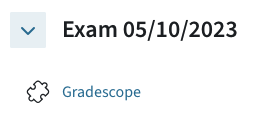
- Open the Gradescope activity and you will be taken to Gradescope. You will be asked which Gradescope course and assignment you want to link. Select „new assignment“.
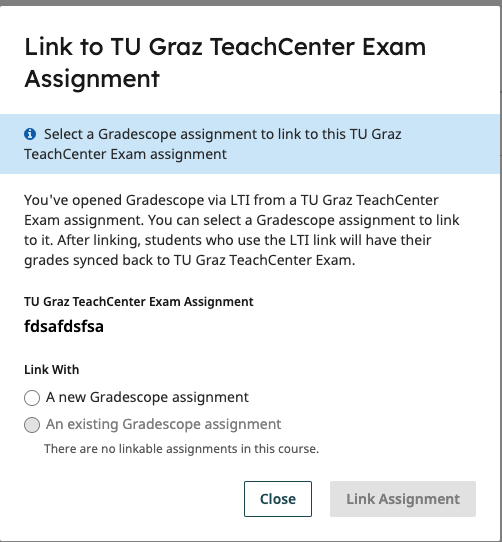
- If errors occur during linking, you can go to the Gradescope course settings or assignment settings at any time and click on „Unlink“, which removes the link, and then link them again.
Creating Gradescope Exam
Homework
- Click „Create assignment„. Select the Homework/Problem Set option and click Next.
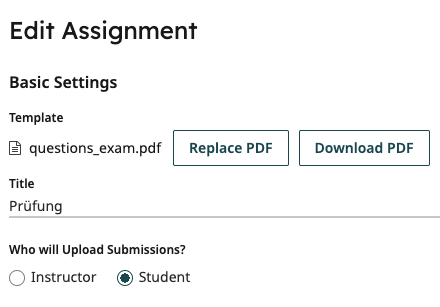
- You will need to give the assignment a title and upload a file with questions or a problem to solve.
- By default, the Homework/Problem Set assignment type is set so that students will upload their own work. If you want to scan and submit the work, you can change the „Who will upload submissions“ setting.
- Set the release date, due date and time limit.

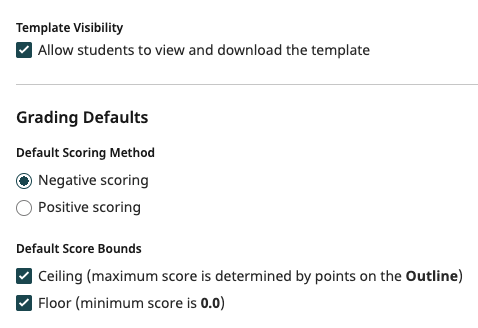
- Allow students to view the template in Template Visibility so they can download the questions or problem to solve.
- Then create an outline of your exam by adding new questions via the plus icon and entering the maximum points for each question. The outline is used for grading later.
Exam/Quiz
- Click „Create Assignment„.
- Select Exam / Quiz. Click Next.
- Give the assignment a title and upload a blank copy of the exam.
- By default, the Exam/Quiz assignment type is set up so that teachers will scan and upload the documents. If you want students to scan their own work, change the setting in Who will upload submissions?
- Create the exam template
- Highlight the areas in the PDF where students are going to write their answers. You will see exactly this area during grading later.
- Transfer your questions to a digital outline. Click + new question to start adding questions. You can title your questions and add maximum points. Create sub-questions by clicking on the plus next to a question or dragging one question onto another. This outline will be used for grading later.
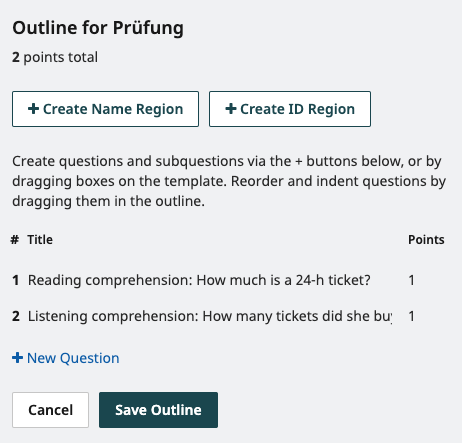
- You can also define areas where students enter their name and matriculation number. These areas are optional, but very useful if submissions are scanned centrally, as an AI feature can recognise the handwriting and automatically assign the submission to the correct person.
Bubble Sheet
- By default, the Bubble Sheet assignment type is set up for teachers to scan and upload the answer sheets. However, you can change this setting in Who will upload submissions?
- If you enable the Template Visibility, students will be able to download a blank template containing 200 questions with five answer bubbles each.
- Create your answer key for later grading.
Programming task
- Create a new programming task, give it a title and description.
- If you are manually grading the code, the following steps are the same as for a homework assignment.
- If you want to use an autograder, set up the autograder (external site) .
Synchronising students
All students registered for the course or the exam automatically have access to the TeachCenter (Exam) course. To transfer them from the TeachCenter (Exam) to Gradescope, you must manually (!) click the button „Sync TU Graz TeachCenter Exam Roster“ or „Synchronise TU Graz TeachCenter Exam User List“ on Gradescope.
Students complete the assignment or exam
- If students need to download instructions from Gradescope, they enter via the TeachCenter (Exam), agree to the privacy policy there and click on the link that takes them to Gradescope. Students should be logged in to Gradescope automatically (TUGRAZonline credentials).
- If the exam or assignment is written on paper and students also receive the instructions on paper, please still inform the students about the privacy policy (external site) , for example by sending an email in advance or by printing out the document.
- If students have to scan their answers themselves, they enter the TeachCenter (Exam) course (again) and follow the link to Gradescope, where they will find the upload option.
Grading the assignment and exporting scores
- To start grading, go to the Grading tab and click on the question you want to grade.
- Grading on Gradescope is done through „rubrics„, which allow you to grade quickly and consistently.
Rubrics consist of a point value and an explanation. Points can be awarded negatively or positively (negative = starting from the maximum score, with deductions for mistakes, or positive = starting from 0 points, with points for each correct answer; this is defined in the settings of the activity).
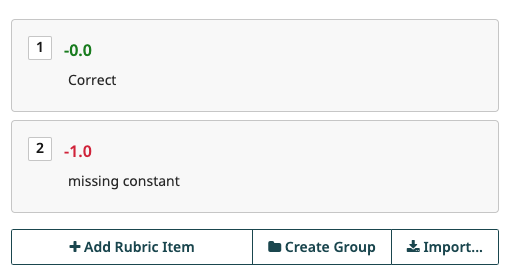
Rubrics can be created directly while grading or in advance when creating the assignment .
- Rubrics can be created directly while grading or in advance when creating the exam.
- Select + Add rubric entry and add the points and description. All other people grading the exam will see this new rubric in real time and can use it. We advise you to create detailed rubrics instead of just „correct“ and „incorrect“ to make grades more transparent for students.
- For faster grading, simply press the number on the keyboard that corresponds to the rubric.
- To move to the next answer to the same question, go to Next ungraded. This avoids several people grading the same answer at the same time.
- For homework or exams/quizzes, you can also leave comments or sketch with a pencil tool.
- When all answers have been graded, export the scores to the TeachCenter (Exam) using the corresponding button. Students will find their points in the TeachCenter (Exam), and can view the entire assignment on Gradescope once the grades have been published.
For specific information on AI grouping of answers and grading, see the Gradescope help pages (external site) .
Help & contact
We highly recommend a test submission if you or your students are not yet familiar with Gradescope.
For questions about Gradescope: Gradescope support. Please keep Teach-Center support in CC so that the TC support also knows about any issues.
For more help, see these how-to guides by Gradescope:
Help on question types and creating assignments (external site)
Help specifically for exams that are written in a lecture hall and scanned (external site)
Help for students (external site)
Help on grading (external site)
For questions about the TeachCenter or TeachCenter Exam: tc@tugraz.at
- Published
- Updated